

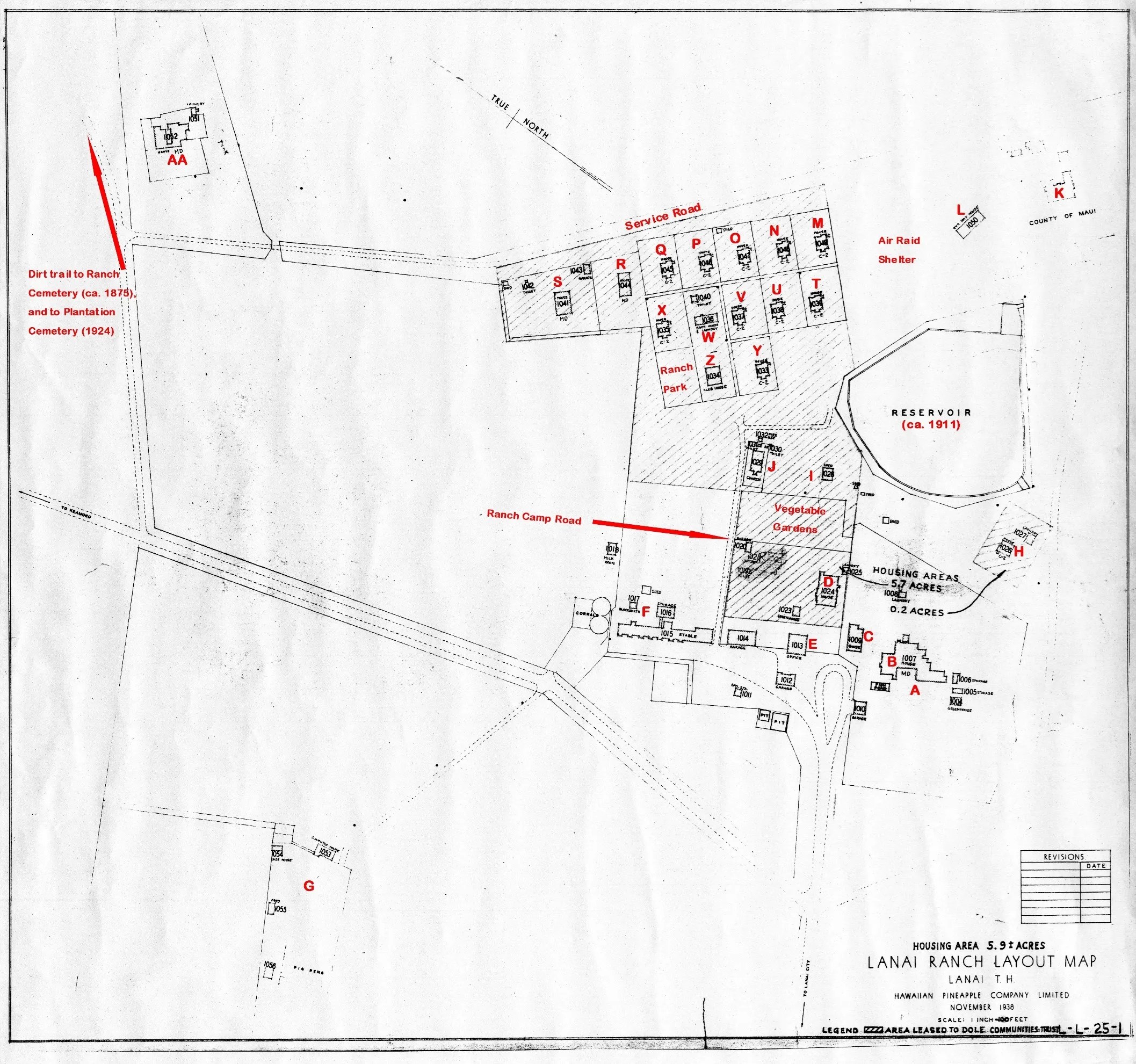
 On March 28, 2025, a public hearing of the Maui County Council (Bill 3, FD1 2025) was held as the County was been asked to decide the fate of the last two historic ranch homes at Kō‘ele, Lāna‘i. Even though much of the cultural landscape has been destroyed there is a rich history at Kō‘ele. The remaining Hawaiian Church and two ranch homes (originally built in 1899) are among the last physical manifestations of the kama‘āina presence and cultural attachment at Kō‘ele. While the cultural-historic landscape has been all but erased, the significance of place and the remaining features are a connection of generational Lāna‘i residents to their beloved home. The notes and photos/map below provide viewers with a glimpse into facets of the history of Kō‘ele. This annotated map depicts Kō‘ele as it was built out in 1938. For details on the features identified on the map, please click the link below to the narrative testimony we submitted to the Maui County Council.
Our testimony may be accessed here 2025 03 25 Bill 3 (Protect Two Remaining Koele Ranch Houses In Place) (PDF 8 pages)
 Ohana Members Include:
Sylvester Apiki, Enoka Makahanaloa, Pili Kahoohalahala, Kama Mano, Jacob Apiki, James Kauila, John Naauao Kaopuiki, Ben Kahaleanu, Bobby Keliihananui, Peter, Kawelo, Koanui Piimoku, Maggie Nakihei, Maria Gibson, Robert Kauila, Eliza Manoa, Maka Likua, Bon Soon Shin, Gi Hong Kwon, Robert Cockett, David Keliihananui, Esther Kaehuaea, Rose Kahikiwawe Cockett, Maleka Apiki Piimoku, Eliza Kalanikini, Makaimoku, C. Forbes, Jean & George Munro, Hector Munro, Julia Honolii, Malia Mano, Annie Mikala Cockett, Wilson Kwon (baby), Elizabeth “Kapeka” Napuehu Kwon, Imiola (Kahikiwawe) Likua, Ann Shin, Mahoe Kauila, Joseph Makahanaloa, Hanna Kauila. (Names provided by Lloyd Cockett)
The School House later became the home of John and Hannah Richardson.